Emma Sharp • February 11, 2026

RCPA Shares DHS Secretary Arkoosh Budget Presentation Overview

Author

Emma Sharp

Date

February 11, 2026

Share

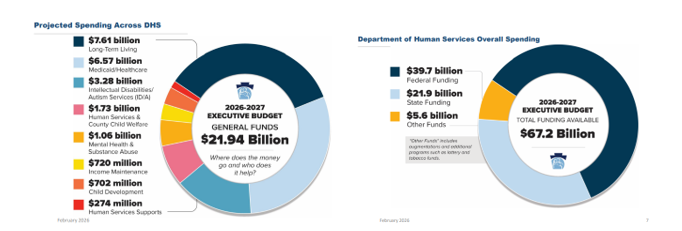
On Friday, February 6, Department of Human Services (DHS) Secretary Val Arkoosh presented an overview of Governor Shapiro’s proposed Fiscal Year (FY) 2026/27 budget and detailed the projected spending across DHS, which totals $21.94 billion in state funding. 

The Secretary highlighted that all three Medicaid managed care programs, as well as waiver programs for people with intellectual disabilities and autism, are receiving increases, largely driven by patient needs and costs associated with delivering care. The proposed FY 2026/27 budget includes $39.7 billion in federal funding as well as $5.6 billion from augmentations and additional programs, such as lottery and tobacco funds, making the total DHS funding $67.2 billion.


The Secretary expressed how the proposed budget reflects the direct impacts of HR 1, with significant federal funding at risk. The distribution for the 2026/27 budget is based upon the current structure of Medicaid and other federally funded programs, but the Secretary noted that beginning in 2028, changes in Medicaid financing rules will remove $20 billion from Pennsylvania’s Medicaid program over the following decade.

Two donut charts showing the 2025 Executive Budget ($21.94B) and Department of Human Services total spending ($67.2B).

Budget Highlights and Investments

  • Investments in Health:
  • Food is Medicine: $900,000 (federalizes to $2.3 million) in state funds to launch a pilot program that will provide nutritionally appropriate food to improve quality of life and health outcomes while lowering overall health care costs for Medicaid recipients with significant health care needs.
  • Housing Stability: $1 million in state funds (federalizes to $2.5 million) to launch a pilot that will connect people experiencing homelessness to stable housing and services that improve health and care management.
  • Reentry Supports: $900,000 in state funds (federalizes to $2.7 million) to provide pre-release coverage (up to 90 days prior to release from a State Correctional Institution) for substance use care and intensive case management.
  • Continuing ODP Multi-Year Growth Strategy: Building upon Shapiro’s 2024 multi-year strategy to expand access to home and community-based services and effectively end the emergency waiting list of adults with intellectual disabilities with autism, the proposed budget allots $30 million in state funds, which federalizes to $66.2 million. This will allow for 850 more people to be served in the Community Living Waiver and 400 more people to be served in the Consolidated Waiver.
  • Supporting 988 Call Centers and Crisis Services: The proposed budget includes a $10 million investment in the crisis response workforce to help 988 call centers, as well as $5 million in state funds to continue prior year commitments for emergency behavioral walk-in centers.
  • Sustaining Early Intervention Rate Increase: The Secretary stated that the EI line item in the executive budget reflects the changing state cost to run the program and not an anticipated cut in funding. The release of the DHS Blue Book will have more information about the total funding with federal match. DHS intends to keep the new, updated rates from the 2025/26 budget, and revised rates will be released soon.
  • County Base Mental Health Services Funding: RCPA has confirmed that there will be no allocation increase for county base funding. While previous budgets had included $20 million for county base mental health funding, it was not included in the 2025/26 budget or the proposed 2026/27 budget.


Due to technical difficulties, DHS was unable to record the webinar, but the presentation slides and transcript can both be viewed.


Please contact your RCPA Policy Director with any questions or concerns.

PA ODP logo with dark blue border
By Tim Sohosky May 29, 2026
On Thursday, May 28, the Office of Developmental Programs (ODP) provided an update to the Medical Assistance Advisory Committee (MAAC) regarding current policies and upcoming regulatory changes following a recent Commonwealth Court decision. On February 17, 2026, the PA Commonwealth Court issued a decision in Dunkelberger v. Department of Human Services that determined that ODP’s limitations on provider model services (specifically the 40/60-hour caps and 90-day travel maximums) were null and void. The decision was based on process rather than policy validity; the Court found that these limitations were not properly promulgated as regulations in accordance with the Commonwealth Documents Law and Regulatory Review Act. To maintain a balanced approach between flexibility and oversight, ODP is moving forward with the following actions: Regulatory Amendments: ODP will amend regulations to establish formal authority for setting service delivery limits that support individual welfare and program integrity. Self-Directed Model Agreements: ODP has already modified agreements for self-directed models to clarify limits on overtime, combined relative service provision, and travel restrictions. Travel Restrictions: Due to the inability to monitor services effectively over long distances, service provision will now be limited to Pennsylvania and contiguous states. Waiver Changes: ODP will seek modifications through the amendment process to the Consolidated, P/FDS, Community Living, and Adult Autism Waivers to include: New requirements for agencies providing IHCS and Companion services to disclose a DSP's relationship to participants; and Strengthened programmatic oversight and integrity measures. Life Sharing Alternative: For participants requiring more than 60 hours of paid care from a relative, the Life Sharing (24/7) service model remains the recommended alternative. ODP anticipates a public comment period for these proposed waiver changes beginning in January 2027.
Yellow screen with the words
By Cathy Barrick May 28, 2026
The Office of Developmental Programs (ODP) has shared ODPANN 26-039 . The purpose of this communication is to provide updated details about the Residential Performance-Based Contracting (PBC) Pay-for-Performance (P4P) initiatives for Fiscal Year 2026/27. Updates are provided in red . Please review the announcement for more details. Visit here to access the Pay for Performance (P4P): Residential Rural Capacity Expansion Plan template .